Four Dials That Power Canadian Banking: NIM, Fee Mix, Liquidity & Capital

Introduction
If you work in financial services, or you're simply curious about how banks stay healthy, you've probably heard terms like NIM, D-SIB, capital ratios, or liquidity coverage. They sound daunting, but they're actually elegant measures of how a bank makes money, survives stress, and manages risk.
I recently built a tool called the Banking Economics Dial Explorer to demystify these for strategy teams at Canadian banks. In this post, I want to share what those four dials measure, why they matter, and how projects across the organization move them.
Whether you're pitching a digital deposit initiative, launching a wealth platform, or optimizing your mortgage business, understanding these metrics will help you frame the impact in language that resonates with leadership.
🔥 Click Here to Check it Out! 🔥
Dial 1: Net Interest Margin (NIM)
What it measures: The profit margin on the bank's core lending business—the spread between what the bank charges for loans and what it pays for deposits.
Plain English
- Interest Income: Money the bank earns from lending—mortgage payments, loan interest, credit card rates, and returns on bonds it holds. Think of it as rent charged for lending out money.
- Interest Expense: Money the bank pays for its funding—interest on savings accounts, GICs, and wholesale borrowing. The cost of using other people's money.
- Earning Assets: The total pool of assets that generate interest income—loans, mortgages, bonds, and investments. Not all assets earn interest (buildings, ATMs don't count).
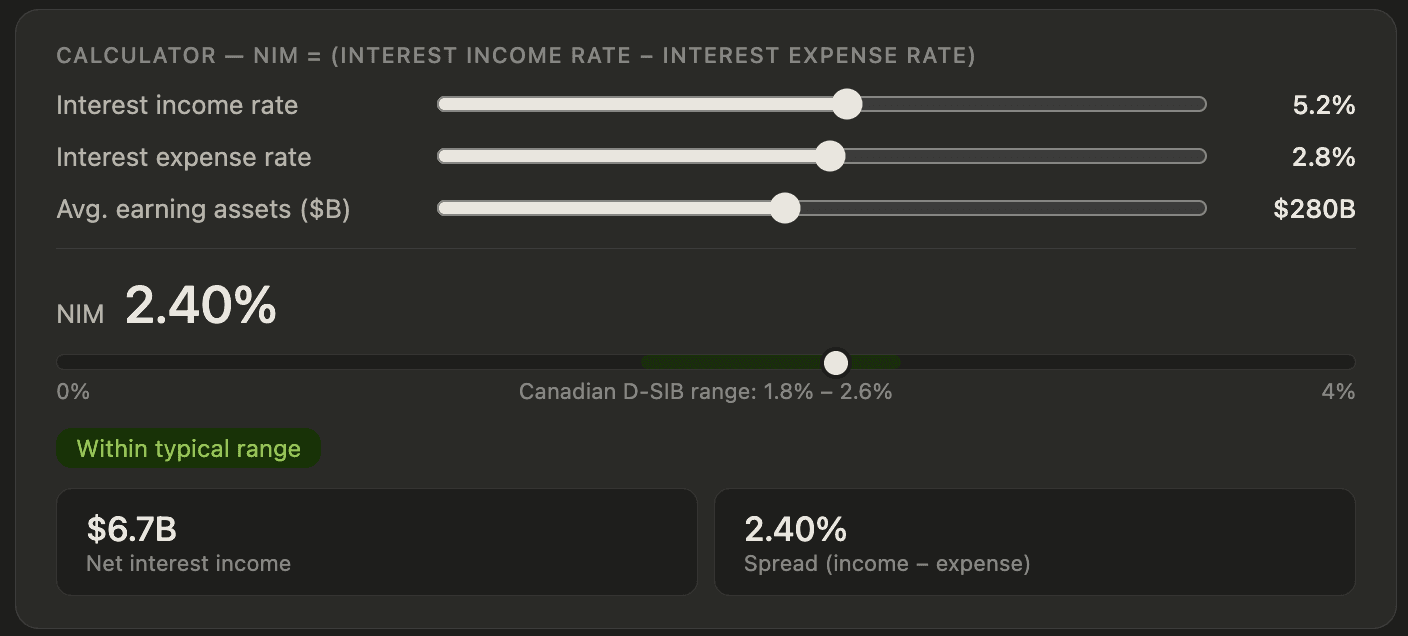
The formula: NIM = (Interest Income Rate - Interest Expense Rate) / Average Earning Assets × 100%
Why It Matters
A healthy NIM is the heartbeat of a retail bank. If the bank earns 5.2% on loans and pays 2.8% for deposits, NIM is 2.4%—a solid margin. In Canada, D-SIBs typically run NIMs between 1.8% and 2.6%.
A wider NIM means more profitable core banking. A narrowing NIM can signal competitive pressure on loans, rising deposit costs, or a shift toward lower-yielding assets.
How Projects Move This Dial
- Digital deposit growth: Lower-cost deposits reduce the interest expense rate → wider NIM
- Mortgage platform modernization: Faster approvals = more interest-earning assets
- GIC renewal automation: Higher retention on maturing GICs keeps cheap funding costs stable
- Rate repricing strategies: Protects spread in rising or falling rate environments
Dial 2: Fee Mix (Non-Interest Income Ratio)
What it measures: What proportion of total revenue comes from fees vs. the lending spread—a measure of earnings stability.
Plain English
- Spread Income: Revenue from lending and investing—the interest margin. It moves up and down with interest rates and loan volumes.
- Fee Income: Revenue that doesn't depend on interest rates—monthly account fees, credit card interchange, wealth management fees, insurance premiums, transaction charges. This income is stable and predictable regardless of rate cycles.
- Revenue Mix: The proportion of total revenue from fees. A higher fee mix is prized by investors because earnings are less exposed to rate swings.
The formula: Fee Mix = Fee Income / Total Revenue
Why It Matters
Canadian banks typically target a fee mix of 30–42%. This diversification matters. When interest rates fall sharply (like they did in 2020), banks with higher fee mixes suffered less earnings shock because fees remained stable.
A 40% fee mix is like insurance—it smooths earnings volatility and gives leadership more certainty on guidance.
How Projects Move This Dial
- Card and payments modernization: Higher interchange + annual fees; digital wallets drive volume
- Wealth and advisory platforms: AUM growth → management fees at lower cost per client
- Branch modernization: Shifts advisors to advice → higher referral conversion on fee-bearing products
- Digital investment platforms: Lower effort, recurring AUM-based fees
Dial 3: Liquidity Coverage Ratio (LCR) & Net Stable Funding Ratio (NSFR)
What they measure: Can the bank survive a funding crisis? Do it have enough stable funding for the long term?
Plain English
LCR (30-day stress test):
- HQLA = High Quality Liquid Assets—cash and near-cash instruments (GoC bonds, provincial bonds) that can be sold instantly without losing value.
- Net Cash Outflows = How much money the bank bleeds out in a panic scenario. Depositors withdraw, credit lines get drawn, wholesale lenders don't renew. Regulators assign a run-off rate to each liability type.
- Chequing account: ~5% run-off (you probably won't close it in a panic)
- Wholesale funding: 25–100% run-off (institutions won't renew)
- LCR = HQLA ÷ stressed outflows. Must be ≥ 100%. Canadian banks typically run 125–155% as a buffer.
NSFR (1-year stability test):
- Does the bank have enough long-term stable funding to cover its long-term assets?
- Retail deposits score much better than wholesale funding here.
- Also must be ≥ 100%.
Why It Matters
These are regulatory requirements, but they also tell you something deeper: Does this bank have a sticky funding base?
During the 2008 crisis, banks with heavy wholesale funding nearly collapsed when overnight funding markets froze. Banks with strong retail deposit franchises survived better.
A solid LCR and NSFR signal:
- Resilience to funding shocks
- A competitive deposit franchise
- Less dependence on wholesale markets
How Projects Move These Dials
- Retail deposit acquisition: Low run-off rates reduce stressed outflows → LCR improves
- Wholesale funding reduction: Replacing short-term wholesale with retail deposits → NSFR improves significantly
- Deposit automation and stickiness: Higher renewal rates = lower implied run-off rates
- Liquidity reporting and forecasting: Better data can reduce OSFI-required HQLA buffers
Dial 4: CET1 Capital Ratio
What it measures: How much of a safety cushion does the bank have to absorb losses?
Plain English
- CET1 Capital = Common Equity Tier 1 capital—the bank's highest-quality shock absorber. Mostly retained earnings (profits kept, not paid as dividends) plus common shares. If the bank suffers massive losses, CET1 absorbs them first. It's the bank's skin in the game.
- Risk-Weighted Assets = Not all assets carry the same risk. A government bond is near-zero risk; an unsecured personal loan is high risk. Regulators adjust assets by riskiness. A $1M mortgage might count as $350K of RWA, while a $1M personal loan counts as $1M.
- CET1 Ratio = CET1 capital ÷ RWAs. The bank's safety buffer as a percentage.
The formula: CET1 Ratio = CET1 Capital / Risk-Weighted Assets
Why It Matters
OSFI (the Canadian regulator) sets a floor for D-SIBs of ~11.5% including buffers. Running above that floor gives the bank:
- Capacity to grow loans and mortgages (which carry RWAs)
- Capacity to pay dividends
- Buffer to absorb unexpected losses
A bank with a 13% CET1 ratio has ~1.5 percentage points of buffer above the regulatory floor. That's room to maneuver.
Below the floor? Growth halts. Dividends get cut. The bank falls under regulatory scrutiny.
How Projects Move This Dial
- Basel IV / regulatory capital: Better risk models = lower RWA per dollar of exposure → higher CET1 ratio
- Loan growth initiatives: More mortgages/loans = higher RWAs → compresses the ratio
- Credit risk data quality: Cleaner PD/LGD data → more accurate IRB models → potential RWA relief
- Cost and efficiency projects: Higher retained earnings → builds CET1 capital over time
Connecting the Dials: A Practical Example
Let's say you're proposing a digital mortgage platform that speeds up approvals and cuts broker costs.
How does it move the dials?
- NIM: More mortgages originated → higher earning assets → NII grows. ✓
- Fee Mix: Digital onboarding fees + reduced reliance on brokers → fee income grows. ✓
- LCR: More stable retail deposits (mortgages lock in customer relationships) → improves fundings. ✓
- CET1: More mortgages = higher RWAs → ratio compressed unless offset by capital generation. ⚠️ (flag for Treasury)
When you frame the project's impact across all four dials, you're speaking the language of the bank. You're not just saying "this will be faster." You're saying: "This grows profitable earning assets, diversifies revenue, strengthens our deposit franchise, and has manageable capital impacts if we approach RWAs strategically."
The Big Picture
These four dials are interconnected. A bank can't just maximize one—they have to balance all four:
- More lending grows NII but also RWAs (capital pressure).
- Wholesale funding is cheap but carries high run-off risk (liquidity pressure).
- Digital deposits are sticky and low-cost, but require significant upfront investment.
Understanding what moves each dial helps you design initiatives that improve the whole system, not just one metric.
Closing Thoughts
Whether you're in strategy, product, technology, or finance, knowing these four dials will change how you think about banking projects. They're not just compliance metrics—they're the heartbeat of the business.
Next time you're in a pitch meeting or reviewing a business case, ask: How does this move NIM, fee mix, liquidity, and capital? The answer will tell you whether you're thinking like a banker.
Have you built or analyzed tools like this? I'd love to hear how your organization frames banking economics to teams. Reach out or share your thoughts—I'm always curious about how different banks approach strategy alignment and metrics communication.